Advanced BDSM Safety Guide: Readiness, Consent, and Smarter Scene Planning
Advanced BDSM is less about collecting extreme activities and more about building enough trust, skill, consent, and recovery planning to handle stronger experiences responsibly. If you are searching for advanced BDSM ideas, toys, roleplay scenarios, edging, sensory deprivation, foot worship, impact, or other higher-intensity dynamics, the useful question is not "How far can we go?" It is "What do we understand well enough to negotiate, monitor, stop, and recover from?" KinkTest's privacy-friendly tools can help turn curiosity into language for boundaries, preferences, and partner conversations; a calm kink self-reflection starting point is often more useful than jumping straight into a scene list. This guide offers an educational framework, not medical, mental health, or legal advice.

What Makes BDSM Advanced?
In search results, "advanced" often gets used as a shortcut for stronger gear, more intense sensation, or riskier acts. That is incomplete. A scene becomes advanced when the margin for misunderstanding is smaller. More variables are involved: physical limits, emotional triggers, role expectations, timing, tools, signals, recovery needs, and the possibility that someone may respond differently than expected.
For that reason, advanced BDSM is better defined by responsibility than by shock value. A beginner scene may use simple restraints but still be poorly negotiated. A more advanced scene might look quiet from the outside because the partners have planned it with care, agreed on limits, practiced check-ins, and built a clear aftercare plan.
This definition also helps separate fantasy language from real-life decision-making. Roleplay can sound intense while still being carefully bounded. A dominant role does not remove the need for consent. A submissive role does not remove agency. A toy, position, or scenario is not automatically safer because it is popular, and it is not automatically better because it sounds more advanced.
Readiness Comes Before Advanced BDSM Techniques
Before exploring advanced BDSM techniques, ask whether the foundation is strong enough. The clearest readiness signs are not confidence, daring, or novelty. They are communication habits.
You are more ready when both people can name hard limits, soft limits, preferred intensity, emotional triggers, medical or mobility concerns, and what a stop signal means in practice. You are less ready when either person feels embarrassed to pause, afraid to disappoint, unclear about the plan, or tempted to "see what happens" with a high-risk activity.
Use a pre-scene conversation that covers:
- What are we curious about, and what are we definitely avoiding?
- What intensity level are we aiming for: mild, moderate, or high?
- What words, gestures, or object-drop signals mean slow down, pause, or stop?
- What body areas, themes, words, or power dynamics are off-limits?
- What should aftercare include, and what should we avoid afterward?
This is where a private tool can help. If someone struggles to name their interests, a private kink exploration tool can provide vocabulary for discussion without treating the result as a fixed identity or final answer.

Safety Protocols: SSC, RACK, and PRICK in Plain English
Many people first learn "safe, sane, and consensual" or SSC. It is a useful beginner phrase because it keeps consent and judgment in the center. The weakness is that "safe" can sound absolute, and BDSM risk is rarely absolute. Risk changes with the people involved, the setting, the tools, the activity, and the day.
RACK means risk-aware consensual kink. It asks participants to understand foreseeable risks, choose knowingly, and build safeguards. PRICK means personal responsibility, informed consensual kink. It adds that each person should be honest about their own knowledge, limits, and accountability.
For advanced BDSM, these frameworks work best as questions:
- What could go wrong physically, emotionally, or relationally?
- Which risks are acceptable, which are reducible, and which are not worth taking?
- Who has the skill to monitor the scene, and who has permission to stop it?
- What is the recovery plan if the scene brings up unexpected feelings?
- What information do we still need before trying this?
The point is not to drain the scene of intensity. The point is to make intensity chosen, bounded, and reversible.
Advanced Ideas Without Escalating Too Fast
Advanced BDSM ideas do not have to begin with the highest-risk category. Many couples get more satisfying results by increasing structure, communication, or sensory detail before increasing danger.
Advanced edging techniques, for example, can focus on timing, verbal check-ins, and clear stop points rather than pushing someone past their stated capacity. Sensory deprivation can be approached through simple, removable limits such as a blindfold and quiet environment before any complex restraint or reduced communication. Roleplay can move from beginner to advanced by adding a written scene outline, agreed language, and a debrief, not by removing boundaries.
Foot worship, foot fetish scenes, and foot domination can also be negotiated as structured intimacy rather than treated as a punchline or a demand. Advanced foot worship techniques may involve pacing, ritual, service language, hygiene preferences, footwear boundaries, or power exchange cues. Trampling and any weight-bearing activity require extra caution because pressure, balance, joints, breathing, and panic responses can change quickly. If an activity affects breathing, circulation, mobility, skin integrity, or trauma responses, treat it as higher risk and seek qualified, in-person education before attempting anything beyond low-intensity exploration.
Toys and Gear Are Not a Substitute for Skill
Searches for advanced BDSM toys and advanced bondage sex toys often lead to product lists. Gear can expand options, but it cannot replace communication, training, or attention. The most useful question is not "What should we buy?" but "Can we use this safely, cleanly, and within our limits?"
For restraints, consider release speed, circulation, nerve pressure, position strain, and whether the restrained person can communicate clearly. For impact toys, consider body-safe strike areas, warm-up, intensity scale, and whether marks are acceptable. For sensory tools, consider allergies, temperature sensitivity, panic risk, and how quickly the sensation can be stopped.
Good gear habits include inspecting items before use, avoiding improvised restraints that tighten unpredictably, keeping safety tools nearby, and cleaning body-contact items according to their material. Avoid combining multiple new variables in one scene. If a toy is new, keep the roleplay simple. If the emotional dynamic is new, keep the tools familiar.
Scene Planning for Beginner-to-Advanced Roleplay
Roleplay is one of the safest places to build advanced skill because the intensity can live in language, pacing, and structure rather than physical escalation. Popular BDSM roleplay scenarios for beginners and advanced partners may include authority dynamics, service scenes, training scenes, interrogation-style dialogue, or reward-and-denial structures. The ethical difference is planning.
A clear scene plan should include:
- Roles: who is leading, following, observing, or switching?
- Tone: strict, nurturing, playful, formal, or experimental?
- Script boundaries: words or themes that are welcome, limited, or off-limits.
- Time boundary: when the scene starts, pauses, and ends.
- Check-in rhythm: how often the leading partner checks consent.
- Exit ramp: what happens when someone uses a stop signal?
- Aftercare: touch, quiet, hydration, reassurance, space, or a later debrief.
This kind of planning can make a scene feel more immersive, not less. When expectations are clear, partners can relax into the roles because they know where the frame is.

Red Flags That Mean Slow Down
Advanced BDSM requires the ability to pause without shame. Slow down or stop if someone is using pressure, sulking, intoxication, secrecy, threats, or "real BDSM means..." arguments to override a boundary. Also pause if a partner cannot explain the risk of an activity, refuses aftercare, dismisses a safe word, or treats discomfort as proof of commitment.
Physical warning signs can include numbness, tingling, dizziness, confusion, unusual shortness of breath, sharp pain, color change, or panic. Emotional warning signs can include dissociation, sudden shutdown, crying that does not feel chosen or integrated, anger that continues after the scene, or a strong urge to hide what happened.
None of these signs make someone a bad partner or a failed participant. They are information. Advanced practice means respecting information quickly.
Aftercare and Debrief Are Part of the Scene
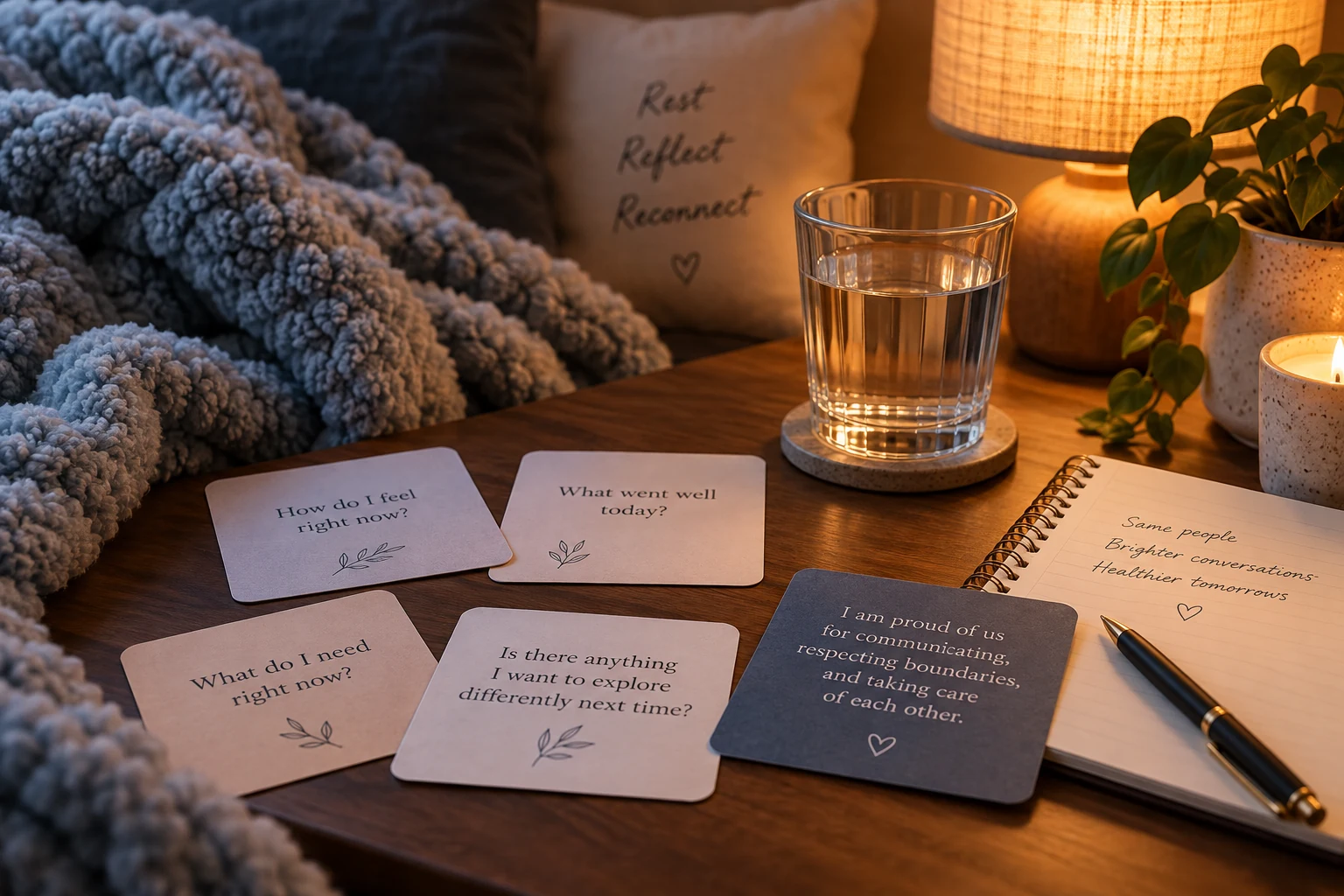
Aftercare is not a soft extra at the end of advanced BDSM. It is part of the plan. Some people need warmth, water, snacks, blankets, reassurance, or physical closeness. Others need quiet, space, a shower, journaling, or delayed conversation. The only reliable answer is the one negotiated before the scene and adjusted afterward.
Debriefing should happen twice when possible: a short check soon after, and a calmer conversation later. The first asks, "Are you okay right now?" The second asks, "What did we learn?" Keep the later debrief specific. What felt good? What felt too fast? Were signals noticed? Did the roleplay language land well? Was the recovery plan enough?
This is also where advanced partners improve without escalating. A scene can become more meaningful because the debrief makes the next negotiation clearer.
A Safer Next Step for Advanced BDSM Exploration
If you are curious about advanced BDSM, choose one variable to explore at a time: one new sensation, one new roleplay structure, one new toy, or one new communication ritual. Keep everything else familiar. That approach gives you cleaner feedback and reduces the chance that intensity, novelty, and uncertainty all stack together.
You can also begin with reflection before action. Review interests privately, compare boundaries with a partner, and use anonymous BDSM preference language as a conversation aid rather than a verdict. The goal is not to prove that you are advanced. The goal is to make exploration more honest, consensual, and easier to adjust.
FAQ
What does advanced BDSM mean?
Advanced BDSM means the scene involves more responsibility, planning, skill, or risk awareness than basic exploration. It does not always mean more pain, more equipment, or more extreme behavior. A carefully negotiated power exchange can be more advanced than a risky scene done without preparation.
Is advanced BDSM safe?
No BDSM activity is automatically safe. Advanced play should be approached through consent, risk awareness, preparation, stop signals, observation, and aftercare. Higher-risk activities require more education and may not be appropriate for every person or relationship.
What are good advanced BDSM ideas for couples?
Lower-risk advanced ideas often involve structure rather than danger: negotiated roleplay, written scene plans, layered consent check-ins, sensation mapping, guided edging with clear stop points, or a detailed aftercare ritual. Add only one new element at a time.
Are advanced BDSM toys necessary?
No. Toys can support certain scenes, but they are not proof of experience. Communication, consent, cleaning, release options, and risk awareness matter more than owning advanced gear. If you use new equipment, keep the rest of the scene simple.
How do SSC, RACK, and PRICK differ?
SSC emphasizes safe, sane, and consensual play. RACK emphasizes informed risk awareness. PRICK adds personal responsibility and informed consent. Many advanced practitioners use these frameworks together as prompts for negotiation, not as magic words that remove risk.
Should beginners try advanced BDSM?
Beginners should usually build foundations first: consent language, boundaries, safe words or signals, aftercare, and simple scene planning. Curiosity is valid, but high-intensity activities should wait until partners have enough knowledge, trust, and pause skills to respond well if something changes.
What should I avoid in advanced BDSM?
Avoid pressure, secrecy, intoxication, ignored stop signals, unclear limits, and scenes where no one can explain the risks. Also avoid stacking too many new variables at once. If an activity affects breathing, circulation, mobility, skin integrity, or intense emotional triggers, treat it as higher risk.