Kink Scenarios: A Safe Planning Guide for Curious Adults
Kink scenarios can be useful when a fantasy feels interesting but too vague to discuss clearly. Instead of treating a scenario as a script you must perform, think of it as a conversation map: who is involved, what mood is being explored, what stays off limits, and how everyone returns to ordinary life afterward. For curious adults, that framing matters. It keeps kink, BDSM ideas, role play sex, and sexual kinks grounded in consent rather than pressure. If you want a private starting point before talking with a partner, the anonymous kink self-reflection tool can help you notice themes, boundaries, and questions worth bringing into a safer discussion.
What Counts as a Kink Scenario?
A kink scenario is a fictional setup that gives structure to a desire. It might involve a role, a rule, a power dynamic, a sensory theme, or a setting. A scenario is different from a kink list because it asks, "How would this actually feel in context?" Someone might be curious about bondage, praise, service, teasing, dominance and submission, or erotic roleplay. The scenario turns that broad interest into a specific container.
For example, "bondage" is a kink type. A scenario could be "one partner agrees to be lightly restrained during a slow, fully negotiated scene." "Power exchange" is a broad BDSM concept. A scenario could be "one partner takes the lead for an agreed window of time while the other can pause or stop at any point." The details should stay adjustable.
Good scenarios are not about proving how adventurous you are. They help people translate fantasy into plain language. That includes naming what sounds appealing, what sounds uncertain, and what is a firm no. This is especially important for intense themes like CNC roleplay or humiliation, where the emotional edge may be part of the fantasy but the real consent must remain clear, current, and easy to withdraw.
Start With Consent Before You Choose a Scene
Before choosing kink scenarios, separate imagination from agreement. A fantasy can be exciting in thought and still not be something you want to try. A partner can enjoy hearing about an idea and still need time before deciding. Consent is not a one-time yes that covers every possible variation.
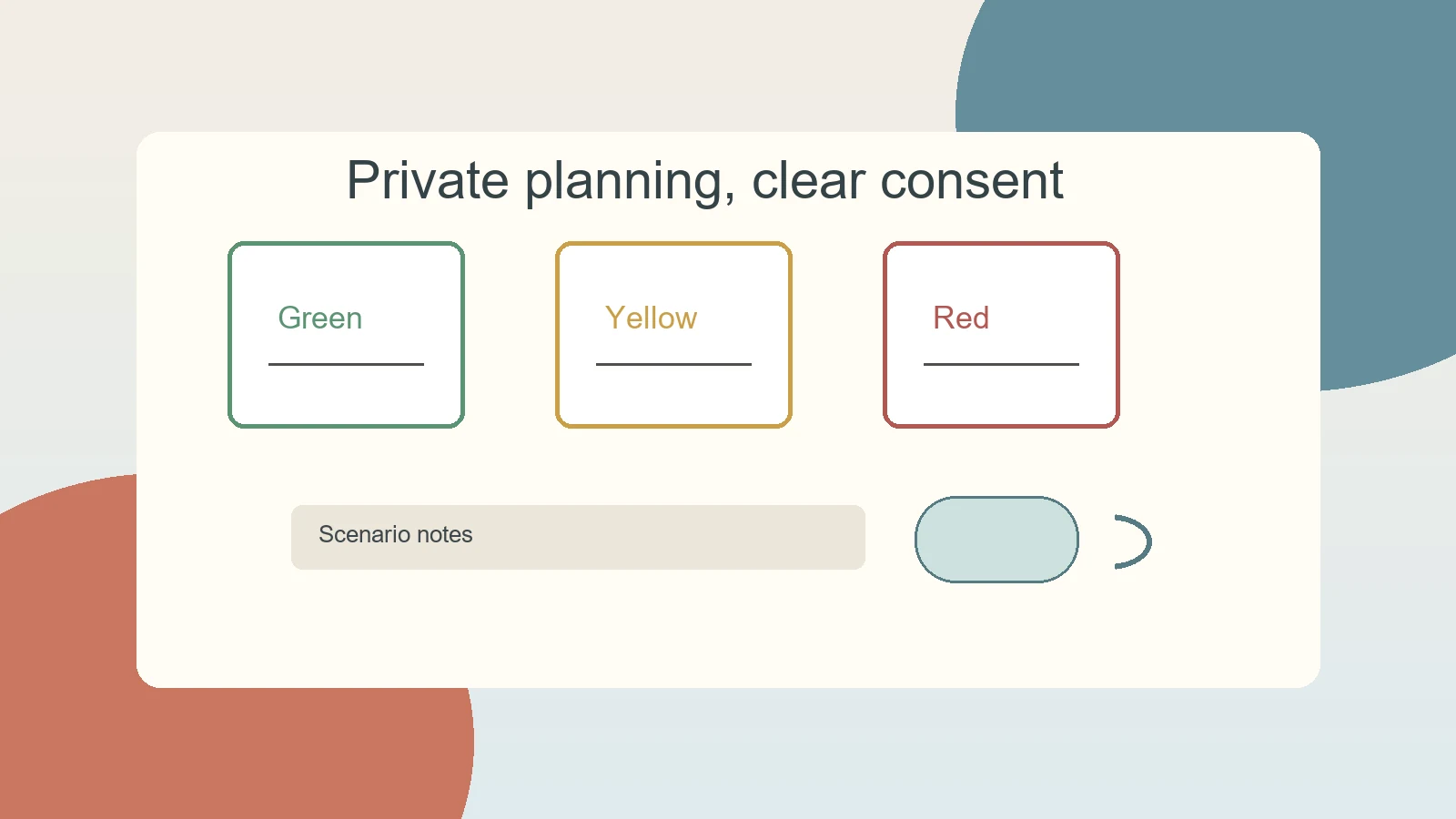
Use three simple categories:
- Green: interests that feel welcome, specific, and comfortable to explore.
- Yellow: ideas that are intriguing but need limits, lighter intensity, or more discussion.
- Red: hard boundaries that should not appear in the scene.
This simple filter works for common kinks, weird kinks, BDSM ideas, and kinky sex ideas because it keeps the focus on people rather than labels. It also reduces the awkwardness of saying no. A red item is not a rejection of the person who suggested it. It is useful information.
After consent, agree on a safe word or safe signal. Some people use a traffic-light system: green means continue, yellow means slow down or adjust, and red means stop. If speech might be difficult, choose a clear physical signal too, such as three taps or dropping a soft object. Then decide what happens after a pause. Do you reset and continue, switch to something milder, or end the scene for the day?
Scenario Types That Help Beginners Think Clearly
Instead of beginning with the most dramatic ideas on the internet, start with categories that are easy to discuss. The goal is not to rank all kinks. It is to notice which kind of structure matches your temperament, relationship, and current trust level.
Sensory Scenarios
Sensory scenarios focus on touch, sound, temperature, texture, or anticipation. They may include blindfolds, soft restraints, massage, teasing, music, or carefully chosen sensations. These can be helpful for beginners because the roles do not need to be elaborate. You can negotiate the setting, the body areas involved, and the intensity level without building a whole character story.
Power Exchange Scenarios
Power exchange scenarios involve one person leading and another following within agreed limits. This can include dominant and submissive roleplay, service tasks, permission games, or structured commands. The safer version is specific and time-bound: who leads, what kinds of requests are allowed, what language is okay, and when the dynamic ends.
If you want to understand your own interest before proposing a scene, a private BDSM preference check-in can give you language for whether the appeal is control, surrender, structure, praise, restraint, or something else.
Roleplay Scenarios
Roleplay scenarios use fictional characters or situations. Popular kinks often overlap with roleplay because acting gives people permission to try a different tone. Keep roles adult, fictional, and emotionally safe. Avoid any setup that makes it hard to distinguish pretend pressure from real discomfort.
A useful roleplay plan has a beginning, middle, and exit. The beginning says how the scene starts. The middle says what kind of dynamic is being explored. The exit says how you leave character, check in, and reconnect. Without an exit, even a mild scene can feel messy.
Restriction and Rule Scenarios
Some scenarios revolve around rules rather than characters. One partner may agree to follow a set of playful instructions, wait for permission, avoid certain actions, or complete a small service task. Rule-based scenes are often easier to scale because you can choose a short time window and a low-stakes rule.
Write the rule in one sentence. If the sentence is vague, refine it. "You are in charge tonight" is broad. "For the next 20 minutes, you choose the pace and I can use yellow or red at any time" is clearer.
A Practical Way to Build Kink Scenarios
You do not need a complicated contract to start thinking. Use a five-part scenario card:
- Theme: What is the appeal, such as restraint, praise, surrender, control, secrecy, service, or novelty?
- Roles: Who is leading, following, observing, switching, or staying outside the scene?
- Limits: What is green, yellow, and red?
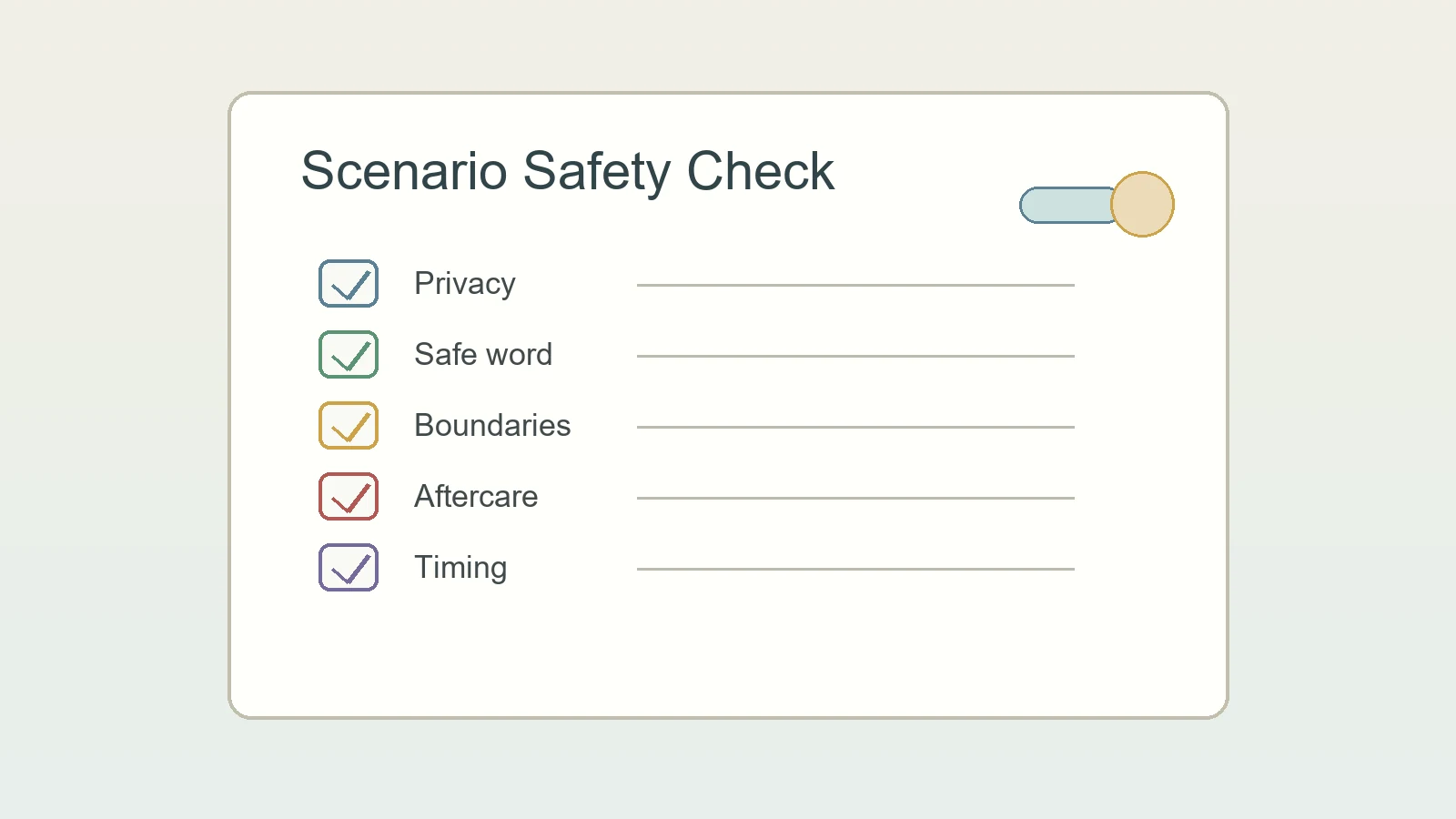
- Safety: What safe word, signal, supplies, privacy checks, and aftercare plan are needed?
- Debrief: What questions will you ask afterward?
Here is a simple example:
Theme: playful authority and praise.
Roles: one partner gives gentle instructions; the other follows or negotiates.
Limits: no insults, no pain, no public setting, no surprises involving other people.
Safety: traffic-light words, door locked, phones silent, water nearby.
Debrief: what felt good, what felt awkward, what should change next time?
This format keeps kinky stuff from turning into guesswork. It also gives you a way to compare different types of kinks without making a person defend every curiosity. A scenario can be interesting, postponed, softened, or discarded.
How to Talk About Kinky Ideas Without Making It Awkward
Many people struggle less with the kink itself than with the first conversation. Try opening with curiosity rather than a demand. You might say, "I read about a scenario format that separates fantasy, boundaries, and aftercare. Would you be open to talking through one idea without deciding anything tonight?"
That sentence does several useful things. It names the topic, removes pressure to act, and gives the other person a chance to opt in to the conversation. It also avoids turning a partner into an audience for a fully formed fantasy before you know how they feel.
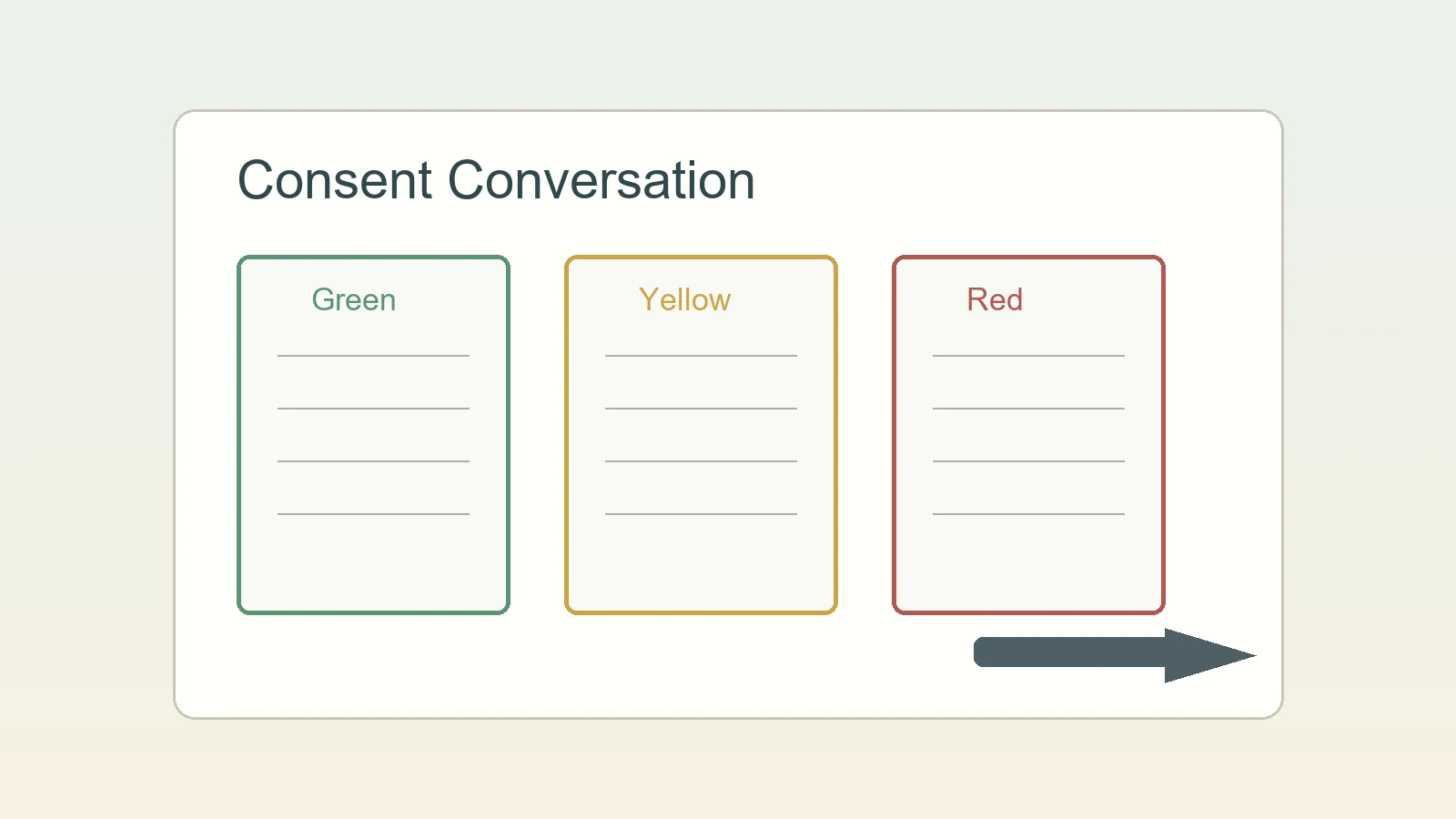
If a partner is interested, trade one green, one yellow, and one red item each. Keep the first round broad. Green might be "praise" or "being told what to do." Yellow might be "light restraint but only hands." Red might be "degrading language." This is often more productive than asking, "What are some kinks you want to try?" because it gives structure without demanding a complete fetish list.
When embarrassment shows up, slow down. Kinks and fetishes can carry shame because people fear being judged or misunderstood. A calm response can protect trust: "Thank you for telling me. I may need to think about it, but I am glad you trusted me with it." You do not have to share the same interest to respond kindly.
Common Mistakes When Planning Kink Scenarios
One mistake is treating scenario ideas as instructions. A blog post, kinky ideas list, or sex role play prompt cannot know your body, trauma history, privacy needs, relationship dynamics, or experience level. Use public ideas as inspiration, not authority.
Another mistake is skipping the boring details. Privacy, keys for cuffs, safer restraint tools, hydration, allergies, physical limitations, and emotional triggers may not sound exciting, but they protect the scene. If a plan involves bondage ideas, sensation play, or any form of restraint, learn the basic safety risks before experimenting. If a plan involves intense psychological themes, talk through emotional limits and aftercare before the scene begins.
A third mistake is escalating too quickly. A person may like a phrase in theory but dislike hearing it in character. Someone may enjoy being guided but not restrained. Someone may want dominance and submission as a mood, not a strict rule set. Small trials are often wiser than dramatic leaps.
Finally, do not make silence do the work of consent. "They did not say no" is not the same as a clear yes. For kink scenarios, the safer question is, "What exactly are we both agreeing to, and how can either of us change our mind?"
Aftercare and Debriefing Are Part of the Scenario
Aftercare is the transition from the scene back into ordinary connection. It can be physical, emotional, or practical. Some people want water, a blanket, a shower, quiet time, cuddling, reassurance, or a simple check-in. Others prefer space first and conversation later. Neither style is automatically better.
Plan aftercare before the scene, not after everyone is tired. Ask, "What helps you feel steady afterward?" and "What should I avoid doing right after?" If the scene includes intense power exchange, taboo language, or vulnerability, consider a next-day check-in too. Sometimes feelings arrive later.
Debriefing does not need to be formal. Use three questions:
- What part felt most connected or interesting?
- What part should we adjust or remove?
- Is there anything we should name before we try another scenario?
This is where a kink scenario becomes a learning tool rather than a performance. The point is not to get everything perfect. The point is to learn what feels consensual, enjoyable, respectful, and sustainable.
Using Kink Scenarios as a Self-Reflection Tool
Kink scenarios are most useful when they help you understand patterns. Maybe your interest is not "all BDSM kinks" but the feeling of being trusted with leadership. Maybe your curiosity about restraint is really about slowing down and receiving focused attention. Maybe your attraction to roleplay is about permission to step outside everyday habits.
If you are exploring alone, write three scenario cards without planning to act on them. Mark each detail green, yellow, or red. Notice repeated themes. Are you drawn to praise, control, surrender, novelty, ritual, sensory focus, or clear rules? This kind of reflection can make partner communication easier later because you are not bringing only a vague request. You are bringing language.
For more private exploration, Kink Test can serve as a low-pressure starting point for kink discovery. Treat any result or reflection prompt as a beginning, not a label you must keep. Your preferences can change with experience, trust, mood, health, and relationship context.
FAQ
What are kink scenarios?
Kink scenarios are fictional setups used to explore a kink, fetish, BDSM dynamic, or roleplay idea. They describe the theme, roles, limits, safety plan, and aftercare so people can discuss an interest clearly before deciding whether to try anything.
Are kink scenarios the same as a kink list?
No. A kink list names categories, such as bondage, praise, service, or dominance and submission. A scenario adds context. It asks how the idea would begin, what boundaries apply, what intensity level is comfortable, and how the scene ends.
What are some beginner-friendly kink scenarios?
Beginner-friendly scenarios are usually simple, short, and easy to pause. Sensory play, praise-based roleplay, light rule-setting, service tasks, and gentle power exchange can be easier to discuss than complex or emotionally intense scenes. The exact choice depends on the people involved.
How do I bring up kinky ideas with a partner?
Start with a conversation, not a request to act immediately. You can ask whether they would be open to discussing a fantasy in a no-pressure way. Share what interests you, what limits you already know, and that their comfort matters as much as your curiosity.
Is CNC roleplay safe to try?
CNC roleplay is an advanced fantasy category because it plays with pretend resistance or pretend lack of consent while real consent must remain active. It requires careful negotiation, clear stop signals, emotional awareness, and strong trust. Many people should avoid it or keep it purely as fantasy.
How many boundaries should a scenario include?
Include as many as needed for clarity. At minimum, name what is allowed, what is uncertain, what is off limits, what words or actions stop the scene, and what kind of aftercare helps afterward. More specific boundaries usually make exploration easier, not less intimate.
Can I enjoy a fantasy without wanting it in real life?
Yes. Fantasy and real-life desire are not identical. A person can find a theme interesting in imagination, fiction, or private reflection and still choose not to act it out. That distinction is normal and worth respecting.