Kink vs. Fetish: Understanding the Difference & How to Explore Safely
If you have ever found yourself confused by the terms kink and fetish, you are certainly not alone. In pop culture, these words are often used interchangeably to describe anything adventurous in the bedroom. However, psychology draws a distinct line between them based on necessity, arousal patterns, and how they influence your sexual satisfaction.
This guide will break down the key differences using simple analogies, help you understand where your desires fall on the sexuality spectrum, and provide a safe framework for exploration. Whether you are looking to understand yourself better or communicate with a partner, getting clarity is the first step toward a healthy, fulfilling sex life. We will also look at how to use tools like our online kink test to map out your preferences without judgment.

What Is the Real Difference Between a Kink and a Fetish?
At the core, the distinction between a kink and a fetish comes down to one simple factor: necessity. While both involve sexual interests outside of what is traditionally considered vanilla (conventional) sex, the role they play in your arousal is what sets them apart.
Understanding the kink vs. fetish meaning can help alleviate shame and confusion. It shifts the conversation from Is this normal? to How does this function for me?
Defining Kink: The Sexual Enhancer
Think of a kink as a nice-to-have. It is an unconventional sexual interest or practice that enhances your arousal and enjoyment, but it is not strictly necessary for you to achieve sexual satisfaction or orgasm.
People with kinks can still enjoy and complete vanilla sex, but adding their specific kink makes the experience more intense or exciting. Kinks are often seen as the spice that adds flavor to your sex life. They are broad and can range from roleplay and light bondage to dirty talk or sensory play.
Defining Fetish: The Sexual Requirement
A fetish, on the other hand, is often described as a need-to-have. In psychological terms, a fetish typically involves a specific object, body part (non-sexual), or scenario that is necessary for sexual arousal and orgasm.
For someone with a true fetish, sexual activity without that specific element might feel flat, unarousing, or even impossible to complete. The object of the fetish becomes the primary focus of desire. For example, someone with a shoe fetish might need the presence of high heels to feel sexually stimulated, regardless of who their partner is.
The Spice vs. Meal Analogy
To make the difference easier to remember, use this simple food analogy:
- Vanilla Sex is the Flour: It is the base ingredient. It’s functional and standard.
- Kink is the Hot Sauce: You add it to the meal to make it taste better. You can still eat the meal without it, but you prefer it with the spice. It enhances the experience.
- Fetish is the Gluten: For a specific type of bread, it is a structural requirement. Without it, the meal (sexual arousal) doesn't really hold together or happen at all.
Common Examples: Where Do Your Desires Fit?
It is helpful to move from abstract definitions to concrete examples. However, keep in mind that the same activity can be a kink for one person and a fetish for another, depending on how much they rely on it for arousal.
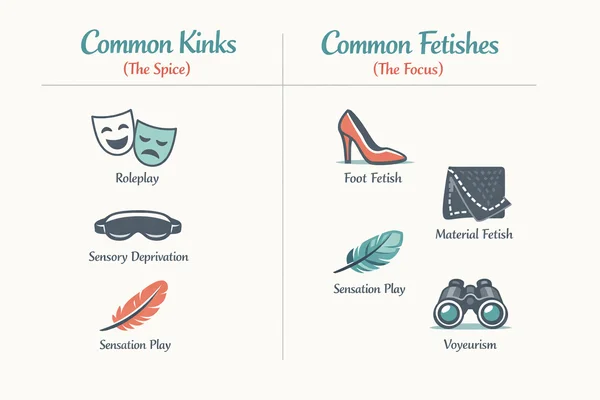
Common Kinks (Enhancements)
These are often activities that couples sprinkle into their routine to break monotony. They are viewed as fun additions rather than requirements.
- Roleplay: Pretending to be different characters (e.g., teacher/student).
- Power Exchange: Light dominance and submission play.
- Sensory Deprivation: Using blindfolds or earplugs to heighten other senses.
- Impact Play: Light spanking or paddling.
- Public Sex: The thrill of potentially being caught (exhibitionism lite).
Common Fetishes (Fixations)
These examples often involve a fixation where the object or body part is central to the sexual act.
- Podophilia (Foot Fetish): Arousal specifically linked to feet, toes, or arches.
- Material Fetishes: A strong need for leather, latex, rubber, or silk to be present or worn.
- Objectophilia: Arousal derived from inanimate objects (e.g., cars, balloons).
- Voyeurism: The specific need to watch others engaging in intimacy to become aroused.
Context Matters: When a Kink Becomes a Fetish
Sexuality is fluid. A behavior that starts as a fun experiment (kink) can evolve into a primary focus (fetish) over time, and vice versa. This fluidity is normal.
For instance, you might enjoy being tied up occasionally (kink). Over years of exploration, you might realize that you struggle to reach orgasm unless you are restrained (fetish). As long as this shift is consensual and doesn't cause you distress, it is simply a change in your sexual profile.
Is Having a Fetish a Mental Disorder?
This is one of the most common questions people ask: Is a fetish a disorder? The short answer is no. Having a kink or a fetish is not, in itself, a mental health issue.
The Role of Consent and Distress
Modern psychology and the DSM-5 (Diagnostic and Statistical Manual of Mental Disorders) make a critical distinction between a fetishistic disorder and a fetish.
A sexual interest is generally considered healthy if:
- It is consensual for all parties involved.
- It does not cause significant personal distress or impairment in your daily life.
- It does not involve harm to non-consenting individuals (or animals/children).
Understanding Paraphilic Disorders (DSM-5 Context)
A paraphilia is an intense and persistent sexual interest other than sexual interest in genital stimulation or preparatory fondling with phenotypically normal, physically mature, consenting human partners.
However, a paraphilia is only considered a paraphilic disorder if it causes distress to the individual or involves non-consenting persons. If you love feet (fetish) and your partner is happy to oblige, that is a healthy sexual expression. If you steal shoes from strangers to satisfy the urge and get arrested, that crosses into a disorder because it involves non-consent and harm.
Why Most Fetishes Are Perfectly Healthy
Research suggests that kinks and fetishes are incredibly common. They are simply variations in human sexuality. Viewing them through a lens of shame can actually be more damaging than the fetish itself. Accepting your desires as a part of your identity is a key step in mental well-being.
The Desire Spectrum: From Vanilla to Fetish
Instead of putting yourself in a box, it is helpful to view sexuality as a spectrum. Most people do not sit 100% in the vanilla category or 100% in the fetish category.
- Vanilla: You prefer conventional sex without toys, roleplay, or power dynamics.
- Kink-Curious: You are mostly conventional but open to trying new things occasionally.
- Kink-Active: You regularly incorporate alternative practices to enhance sex.
- Fetish-Oriented: You have specific requirements for arousal but can function without them occasionally.
- Fetish-Dependent: You strictly require specific stimuli for sexual gratification.
You might engage in different behaviors at different times. Taking a sexual orientation test or a kink assessment can help you visualize where you land on this spectrum today.
How to Discover Your Unique Sexual Profile
Reading about definitions is helpful, but applying them to your own life is where the real insight happens. If you are still unsure whether your interest is a fleeting fancy, a solid kink, or a core fetish, structured self-reflection is the next logical step.
Many of us grow up with shame around sex, which clouds our ability to judge our own desires objectively. We might suppress a harmless kink because we fear it is weird, or we might ignore a fetish that needs to be communicated to a partner.
Asking yourself honest questions—like Do I need this to finish? or How does this make me feel emotionally?—can cut through the confusion.
Using Kink Assessment Tool for Clarity
To help with this process, we have developed a comprehensive assessment. Think of it as an educational mirror. It is not a medical diagnosis; rather, it is a tool designed to help you organize your thoughts and feelings.
By answering a series of neutral, non-judgmental questions, you can see patterns in your desires that you might have missed.
Our KinkTest helps you map out:
- Intensity: Is it a preference or a need?
- Categories: Are you drawn more to sensory play, power dynamics, or object fixations?
- Boundaries: What are your hard no's?
Ready to learn more about yourself? You can take the Kink Test here to start your journey of self-discovery. It is anonymous, safe, and designed solely for your understanding.
How to Talk to Your Partner About New Desires
Once you understand the difference between kink and fetish in your own life, sharing that with a partner is the final piece of the puzzle. This conversation can build immense trust and intimacy if handled correctly.
The SSC Principle (Safe, Sane, Consensual)
The Golden Rule of the kink community is SSC:
- Safe: minimizing risks (physical and emotional).
- Sane: knowing the difference between fantasy and reality.
- Consensual: all parties are fully informed and agree enthusiastically.
Before bringing a kink into the bedroom, ensure your partner understands these boundaries.
Tips for an Open, Non-Judgmental Conversation
- Choose a Neutral Time: Do not bring it up during sex. Pick a quiet time when you are both relaxed.
- Use I Statements: Say I feel really excited by... rather than You never do...
- Start Small: If you have a foot fetish, maybe start by asking for a foot massage rather than jumping straight to the deep end.
- Be Prepared for a No: Your partner has boundaries too. Respecting their no is just as important as expressing your yes.

Final Thoughts on Embracing Your Sexuality
Whether you have a mild kink for blindfolds or a specific fetish for silk, your desires are valid. The most important takeaway in the kink vs. fetish discussion is that neither is bad or wrong. They are simply different ways our brains process pleasure.
By understanding the distinction—kink as an enhancer, fetish as a requirement—you can navigate your relationships with more confidence and less shame. Remember, the goal of exploration is not to fit a label, but to find what brings you joy and connection safely.
If you are ready to dig deeper, consider exploring your KinkTest results to get a clearer picture of your personal landscape.
Frequently Asked Questions about Sexual Preferences
Can a kink change into a fetish over time?
Yes, sexuality is fluid. It is possible for a sexual preference (kink) to intensify over time and become a requirement (fetish) for arousal. This is a common progression and is generally healthy as long as it doesn't cause distress.
Are fetishes genetic or learned?
The exact cause is unknown, but psychologists believe it is a mix of both. Some theories suggest early childhood imprinting plays a role (learned), while others suggest biological predispositions (genetic) influence how our brains map sexual arousal.
Can you get rid of a fetish?
Fetishes are not typically cured because they are not diseases. Most therapists focus on helping individuals manage their fetishes so they can live happy lives, rather than trying to eliminate the desire, unless it is causing harm (paraphilic disorder).
Is BDSM considered a kink or a fetish?
BDSM (Bondage, Discipline, Sadism, Masochism) is a broad category of activities. For most, engaging in BDSM is a kink (an activity they enjoy). However, if someone requires a specific BDSM element (like being tied up) to feel any arousal at all, it functions as a fetish.
Do I need a diagnosis?
You do not need a medical diagnosis for a kink or fetish. These are descriptive terms for your preferences, not medical conditions. You would only seek professional help if your desires involve non-consent, cause you pain/distress, or interfere with your daily ability to function.