What Is CNC NSFW? A Consent-First Guide to Consensual Non-Consent
If you searched "what is CNC NSFW," you are probably trying to decode a term that appears in kink, BDSM, roleplay, or adult-content conversations. CNC usually means consensual non-consent: a pre-negotiated fantasy where adults agree to act out resistance, force, or refusal while real consent remains active underneath the scene. That difference matters. CNC is not permission to ignore someone; it is a high-trust, high-risk form of roleplay that depends on clear boundaries, safety signals, and aftercare. If you are still mapping your interests, a private kink self-reflection tool can help you name curiosities.

What Does CNC Stand For in NSFW Contexts?
CNC stands for consensual non-consent. In NSFW spaces, the phrase describes a fantasy structure where people agree in advance to pretend that consent is being resisted, refused, or overridden inside a scene. The key word is still consensual. The agreement has to happen before the roleplay, and it has to include what is allowed, what is off limits, how someone can pause, and what support is needed afterward.
This is why CNC can be confusing when people encounter the abbreviation without context. The surface of the fantasy may include scripted resistance or language that sounds like refusal. The real-life agreement underneath must be specific, voluntary, revocable, and understood by everyone involved. If that real consent is missing, unclear, pressured, intoxicated, or ignored, it is not CNC.
CNC also sits under the broader BDSM and kink umbrella, but it is not a beginner shortcut. It is often described as edge play because the emotional and physical risks can be higher than in many other fantasies. Some people are curious about the psychology of surrender, control, taboo roleplay, or intense trust. Others may decide the topic is interesting as a fantasy but not something they want to practice.
CNC Is Not the Same as Ignoring Consent
The safest way to understand CNC is to separate performance from reality. In the performance, a scene may include negotiated resistance. In reality, every participant remains a person with agency, limits, and the right to stop. Consent is not a one-time checkbox. It is an ongoing agreement that can change before, during, or after a scene.
That means CNC requires more communication than ordinary roleplay, not less. Partners need to discuss what the fantasy is, what words or actions are part of the script, what words or actions are never acceptable, and what counts as a real stop signal. They also need to talk about emotional risk. A scene can feel exciting in imagination and uncomfortable in practice, especially when it involves themes that resemble coercion.
This distinction is also important because some online content shows intense scenarios without showing the consent conversation that would make a real-life version ethical. Adult media often skips negotiation, safety signals, and aftercare because those parts are less dramatic on screen. Real people cannot skip them. If someone uses "CNC" to pressure a partner, avoid accountability, or claim that "no" never matters, they are misusing the term.
Examples of CNC in the Bedroom, Without Treating Them as Instructions
People ask for examples because the term can sound abstract. A mild example might be a pre-planned roleplay where one partner pretends to resist being kissed, held, or directed, while both people have already agreed on the exact scenario and a stop signal. Another example could involve interrogation-style roleplay, capture-and-escape fantasy, or a scripted power exchange where resistance is part of the acting.
Some versions are sexual. Others may focus more on power, control, restraint, pursuit, or surrender as fantasy themes. What they have in common is not a specific act; it is the structure of prior agreement plus performed resistance. A scenario can be intense in tone but still carefully limited in practice. For many people, safer exploration starts with words, storytelling, or short low-intensity roleplay rather than anything physical.
Before using any example as inspiration, slow down and ask what part of the idea is actually appealing. Is it being desired? Giving up decisions for a short time? Feeling trusted with responsibility? Exploring taboo language? Understanding the motivation can help people choose safer, more precise boundaries.
Types of CNC Kinks People May Mean
"CNC kink" can refer to several different fantasy patterns. Some people mean resistance roleplay, where "no" or "stop" may be part of the scripted performance and a different safety signal carries the real meaning. Some mean free-use fantasy, where partners negotiate when initiation is allowed and when it is not. Some mean capture, interrogation, blackmail fantasy, sleep-related fantasy, or other scenarios that involve loss of control.
These categories are not interchangeable. A person might be curious about verbal control but not restraint. Someone else may enjoy fictional scenarios in writing but not want any real-life enactment. A partner might be comfortable with one setting, one phrase, or one short scene and still have a hard boundary around everything else.
For that reason, it is better to name the specific element than to say "I want CNC" and assume the other person knows what that means. A safer conversation sounds more like: "I am curious about pretend resistance in a clearly planned roleplay, but I do not want pain, surprise, alcohol, or any scene where I cannot use a stop signal." Specificity protects both people.
Safety Basics Before Anyone Tries CNC
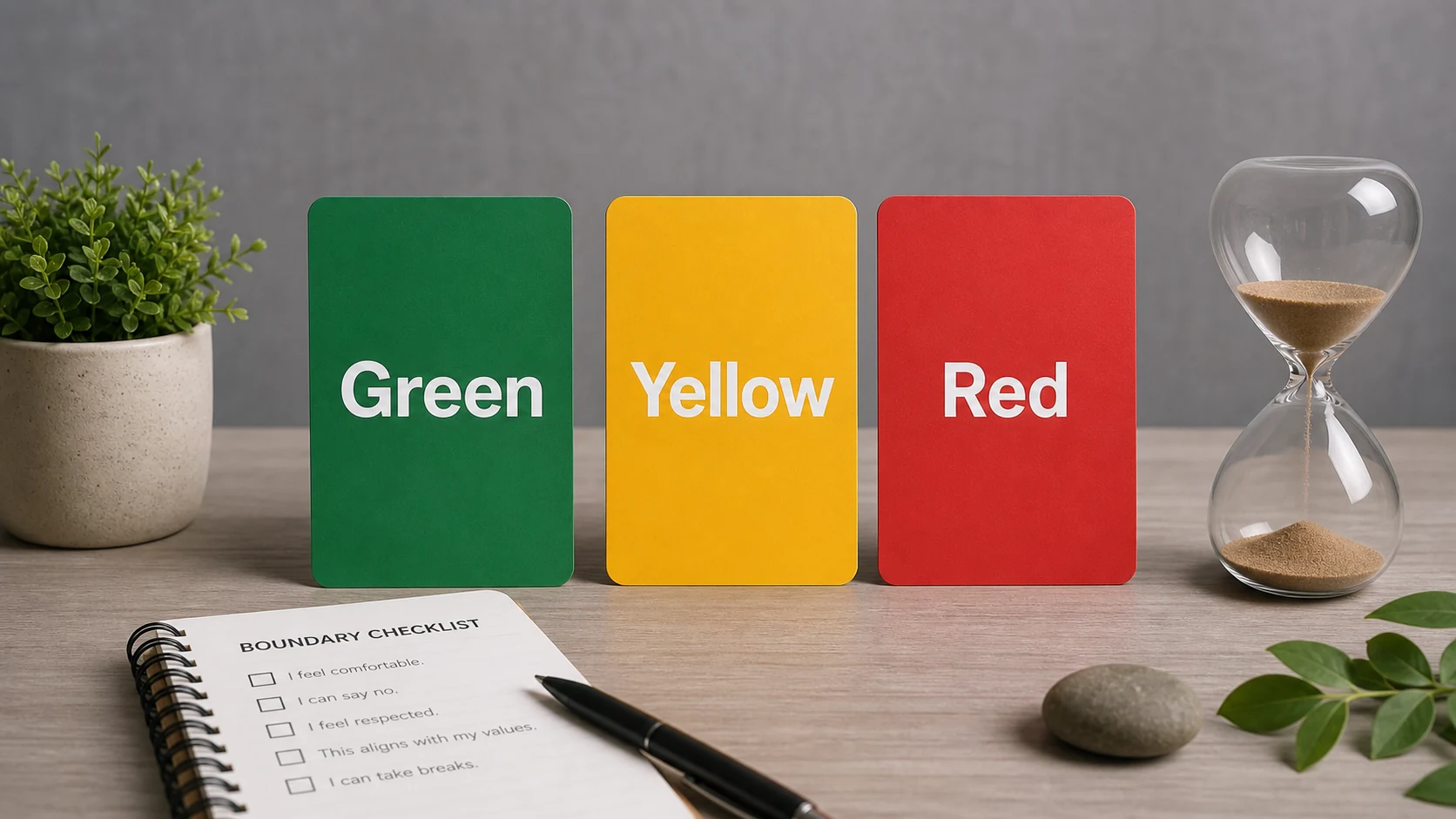
CNC is not something to improvise with a new or unprepared partner. A safer foundation includes trust, sober consent, explicit negotiation, a clear stop mechanism, and a plan for aftercare. Many people also start with a written checklist so they can separate "yes," "maybe," "only in fantasy," and "hard no" items.
Discuss roles first. Who is initiating? Who is receiving? What is each person responsible for monitoring? A dominant or initiating partner still has responsibility to notice distress, check in when needed, and stop immediately if the real stop signal appears. A receiving partner still has the right to change their mind, even if the fantasy script includes resistance.
Next, define safety signals. Some people use the traffic-light system: green means okay, yellow means slow down or adjust, and red means stop. CNC may involve scripted words like "no" or "stop," so partners sometimes choose an unrelated safeword, a nonverbal signal, or both. Nonverbal signals matter if someone could be unable to speak clearly, but any setup that removes a reliable stop option raises the risk.
Finally, plan aftercare. Aftercare can include water, a blanket, quiet time, reassurance, a check-in, journaling, or a next-day conversation. The goal is not to make a scene look polished; it is to help people return to ordinary connection and notice whether anything needs repair.
How to Talk About CNC With a Partner
A good CNC conversation starts away from the bedroom, with no pressure to decide immediately. You might say, "I came across the term consensual non-consent, and I want to talk about what it means before I decide whether it is only a fantasy for me." This keeps the topic exploratory rather than demanding.
Use plain language. Explain what you are curious about, what you are not asking for, and what would make you feel safe enough to keep talking. Ask your partner what feelings come up for them. If they are uncomfortable, curious, uncertain, or uninterested, take that seriously. Consent conversations include the consent to stop discussing the topic.
It can help to use structured kink exploration questions before a partner conversation. Write down the difference between fantasy-only interests, possible future interests, and hard boundaries. That gives both people something calmer to review than a sudden request in a charged moment.
If either person has trauma history, anxiety around coercion, or uncertainty about how they might respond, the conversation should move even more slowly. CNC should never be framed as a healing method or a way to prove trust. If sexual thoughts or relationship dynamics feel distressing, unsafe, compulsive, or hard to manage, consider speaking with a qualified professional or a trusted support resource.
Red Flags That Mean It Is Not CNC
CNC depends on consent, so certain warning signs disqualify it immediately. It is not CNC if one person is pressured, threatened, manipulated, intoxicated, too young to consent, afraid to disappoint a partner, or unable to change their mind. It is not CNC if boundaries are vague and the other person says, "Just trust me." It is not CNC if someone ignores the agreed signal, mocks aftercare needs, or claims that prior consent covers anything they want later.
Another red flag is secrecy that isolates someone from support. Privacy can be healthy, but isolation is different. If a partner discourages you from learning, asking questions, or comparing safety practices, slow down. Ethical kink communities tend to emphasize negotiation, risk awareness, and accountability, not blind obedience.
Pay attention to your body after the conversation too. Feeling nervous is not automatically a no, but dread, shutdown, confusion, or fear of consequences are signs to pause. A safe partner would rather stop early than push someone through uncertainty.

A Safe Way to Reflect on CNC NSFW Curiosity
If the phrase "what is CNC in NSFW" brought you here, the most useful next step may be reflection rather than action. Ask yourself what part of the idea caught your attention, what would be a firm no, what would need to be true for you to feel safe, and whether the fantasy feels exciting, confusing, distressing, or all three.
You do not have to turn every fantasy into a real scene. You can keep something private, read more, talk about it hypothetically, or decide it is not for you. If you want a low-pressure way to map where CNC sits among other interests, an anonymous Kink Test starting point can support self-reflection without treating the result as a label or verdict.
CNC, when discussed responsibly, is less about ignoring consent and more about making consent unusually explicit. The fantasy may involve giving up control, but the real practice should increase clarity, agency, and care.
FAQ
What does CNC stand for?
CNC stands for consensual non-consent. In kink and NSFW contexts, it means adults negotiate a roleplay where resistance or refusal may be performed, while real consent is agreed in advance and remains revocable.
What is an example of CNC in the bedroom?
A mild example is a pre-planned roleplay where one partner pretends to resist a scenario that both people have already discussed, limited, and paired with a real stop signal. The details should be negotiated before anything happens.
What are the different types of CNC kinks?
People may use CNC to describe resistance roleplay, capture fantasy, interrogation fantasy, free-use agreements, sleep-related fantasy, or other power-exchange scenarios. Each type needs its own boundary conversation because the risks and meanings differ.
Is CNC the same as sexual assault?
No. CNC requires informed, voluntary, adult consent before the scene, plus a way to pause or stop. If consent is absent, pressured, ignored, or impossible, it is not CNC.
Is CNC safe for beginners?
CNC is usually considered higher-risk roleplay, so it is not a casual beginner activity. Beginners who are curious should start with education, fantasy discussion, boundaries, and lower-intensity communication before considering any scene.
Can someone change their mind during CNC?
Yes. Real consent can change at any time. Even if a scene includes scripted resistance, partners need an agreed signal that means pause, slow down, or stop in real life.
What should aftercare include after CNC?
Aftercare can include water, warmth, reassurance, quiet time, a check-in, or a next-day conversation. The best plan depends on the people involved and should be discussed before the scene.